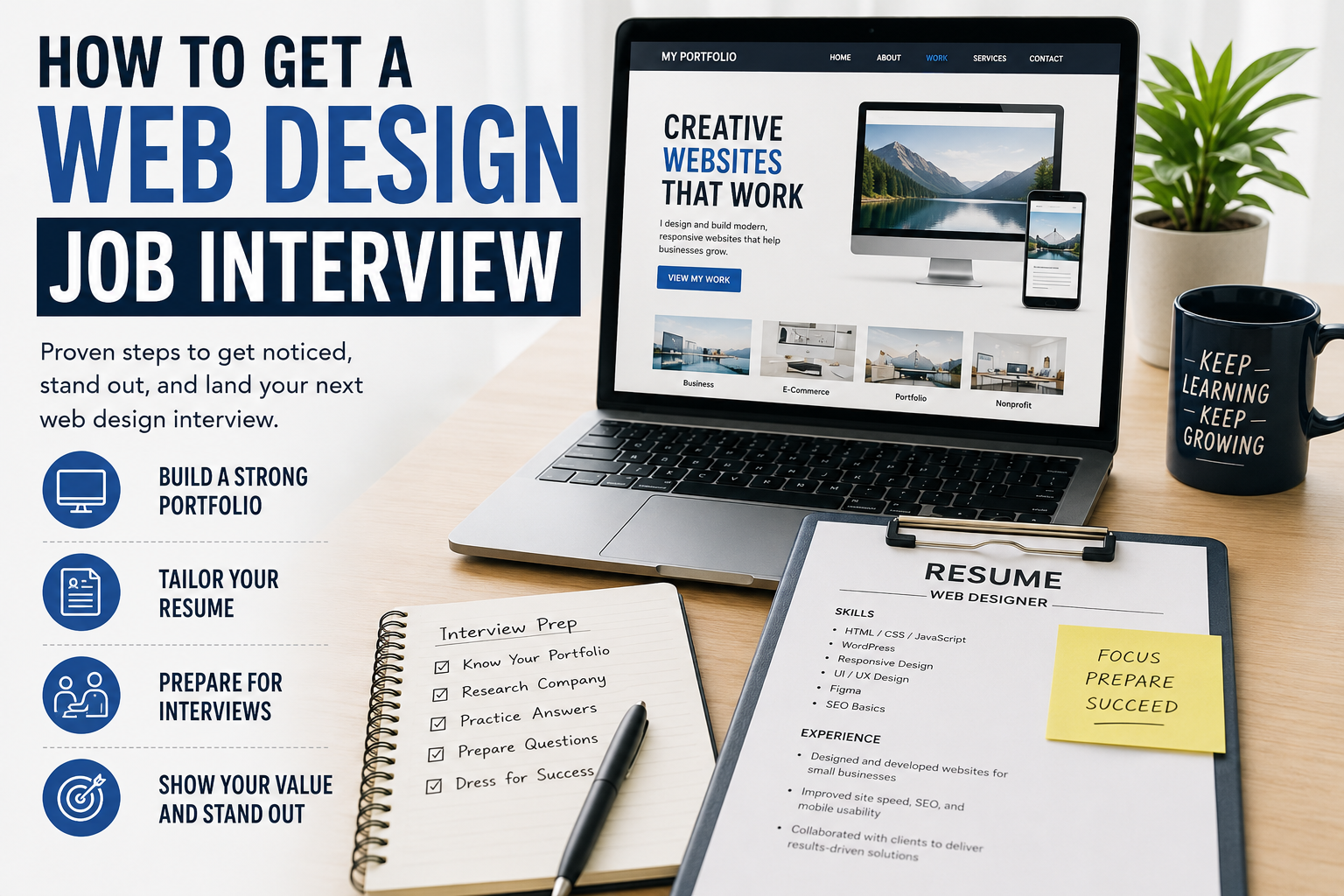
How to Get a Web Design Job Interview
You know how to build websites. You have learned design, WordPress, HTML and CSS, or perhaps platforms such as Webflow, Wix, Shopify, or Squarespace. Now comes another challenge:
How do you actually get a web design job interview?
Getting an interview is not simply about being the most talented web designer who applies. Before an employer can evaluate your skills in an interview, your application has to convince someone that you are worth talking to.
That means your portfolio, résumé, online presence, application, and presentation all have an important job to do.
Here is how to improve your chances of getting noticed and landing that first web design interview.
1. Build a Portfolio Before You Apply
For many web design positions, your portfolio is one of the most important parts of your application.
An employer wants to see what you can actually create.
If you have previous client projects, choose several of your strongest examples rather than filling your portfolio with everything you have ever built.
If you are new to web design and do not have clients yet, you can still create a portfolio.
Build sample websites.
For example, create a website concept for a:
- Local restaurant
- Landscaping company
- Auto repair shop
- Dentist
- Realtor
- Coffee shop
- Contractor
- Nonprofit organization
These do not need to be real customers.
Clearly identify conceptual projects as such, and use them to demonstrate what you can do.
Three impressive sample websites can tell an employer considerably more about your abilities than a résumé that simply says you know web design.
2. Don’t Just Show Screenshots — Explain Your Work
A portfolio becomes more valuable when you explain the thinking behind the website.
For each project, briefly explain:
The Goal
What was the website supposed to accomplish?
The Audience
Who was the website designed for?
Your Approach
How did you organize the pages, navigation, content, calls to action, and visual design?
Your Role
Did you handle design, development, copywriting, SEO, graphics, WordPress setup, or the entire project?
The Result
If it was a real project and you have verified results, explain what changed after the website launched.
This turns a portfolio from a collection of attractive images into evidence that you understand how websites solve business problems.
3. Make Sure Your Own Website Looks Professional
If you are applying for a web design position and provide a link to your personal website, assume the employer will evaluate it.
Your own website becomes part of the interview before the interview even happens.
Check it carefully.
Is it mobile friendly?
Does it load properly?
Is the navigation easy to understand?
Are there spelling mistakes?
Do all of the links work?
Is your contact information easy to find?
Does the website clearly explain what you do?
A web designer’s own website should demonstrate attention to detail.
4. Match Your Résumé to the Web Design Position
Sending the exact same résumé to every employer is rarely the strongest strategy.
Read the job description carefully.
Look for the skills the employer specifically requests.
For example, the position may mention:
WordPress, HTML, CSS, JavaScript, responsive design, UX/UI, Figma, Adobe Creative Cloud, Shopify, SEO, accessibility, website maintenance, analytics, or client communication.
If you genuinely have those skills, make sure they are easy to find on your résumé.
Do not claim experience you do not have.
Instead, make your actual qualifications obvious.
If the employer receives dozens or hundreds of applications, you do not want them searching your résumé to figure out whether you meet the basic requirements.
5. Show Business Skills, Not Just Design Skills
A professional web designer does more than make websites look attractive.
Employers may also value your ability to understand customers, communicate with clients, organize projects, meet deadlines, troubleshoot problems, and work with other members of a team.
Your application should demonstrate these abilities when they are relevant to your experience.
For example, instead of simply writing:
Built WordPress websites.
You could provide more useful context:
Designed and built responsive WordPress websites for local service businesses, including page planning, content organization, mobile optimization, contact forms, and launch preparation.
The second description tells the employer much more about what you actually did.
6. Learn the Skills Employers Are Requesting
Job listings can also be used as free market research.
Look at 20 or 30 web design positions that interest you.
Do not apply immediately.
First, study them.
Write down the skills that appear repeatedly.
You may begin noticing patterns.
Perhaps many employers are requesting Figma.
Maybe WordPress appears frequently.
Perhaps employers want designers who understand basic SEO.
You might find that responsive design, accessibility, UX, HTML/CSS, or e-commerce experience repeatedly appears in the positions you want.
Those patterns can help identify gaps in your current skill set.
Instead of randomly deciding what to learn next, you can concentrate on skills that employers are actually requesting for the type of work you want.
7. Create Projects That Demonstrate Missing Skills
Suppose you discover that several interesting positions require e-commerce experience, but you have never built an online store.
You do not necessarily have to wait for an e-commerce customer to appear.
Build a demonstration project.
Create a fictional online store with product pages, categories, navigation, calls to action, a shopping experience, mobile layouts, and other appropriate features.
Then document the project in your portfolio.
You can use the same strategy for other skills.
Need more WordPress experience?
Build a WordPress website.
Need experience with Figma?
Create a complete website mockup in Figma.
Need local SEO experience?
Create a local business website with well-structured service and location information.
Your portfolio can become a deliberate training tool.
8. Apply for Jobs You Can Realistically Grow Into
Job descriptions often contain long lists of desired qualifications.
Do not automatically reject yourself because you do not match every single item.
Instead, look at the core responsibilities.
Can you perform most of the important work?
Do you understand the primary tools?
Could you reasonably learn the remaining requirements?
If so, the position may still be worth pursuing.
At the same time, be truthful about your abilities.
There is a major difference between saying:
“I haven’t used that platform professionally yet, but I have experience with similar systems and have begun learning it.”
and pretending to have years of experience you do not possess.
The first answer demonstrates honesty and a willingness to learn.
9. Customize Your Application
A generic application makes it easy to look like every other applicant.
Before applying, spend a few minutes researching the employer.
Look at the company’s website.
Understand what the company does.
Read the job description again.
Then tailor your application to the position.
You might mention that your background in WordPress and local business websites closely matches the type of client projects described in the position.
That is more meaningful than:
“Dear Hiring Manager, I am interested in your web designer position.”
Show the employer why this particular job makes sense for you.
10. Make Your Portfolio Easy to Access
Do not make an employer work to see your designs.
Your portfolio link should be obvious.
Your website should work without requiring an account or password unless there is a legitimate confidentiality reason.
Projects should be easy to navigate.
The employer should be able to quickly answer:
What does this person build?
How good is the work?
What skills does this person have?
How do I contact this person?
Reducing unnecessary friction can help your work receive the attention it deserves.
11. Clean Up Your Professional Online Presence
An employer may search your name before deciding whether to schedule an interview.
Review what someone can publicly find about you.
Your professional profiles should accurately reflect your skills and experience.
If you use LinkedIn, keep your work history, skills, portfolio information, and contact details current.
If you use GitHub for development work, make sure the projects you want employers to evaluate are organized and understandable.
You do not have to create an elaborate personal brand.
You simply want your professional information to be consistent and credible.
12. Use LinkedIn and Your Network
Not every web design opportunity begins with an online job application.
Tell people you know that you are looking for web design work.
Former coworkers, business owners, friends, previous clients, developers, graphic designers, marketers, photographers, and other professionals may know of opportunities.
You can also connect with agencies and businesses that employ designers.
The goal is not to immediately ask every new connection for a job.
Build legitimate professional relationships.
When an opportunity eventually appears, being a familiar name can be much more powerful than being applicant number 147.
13. Consider Web Design Agencies
If your goal is to gain professional experience, web design and digital marketing agencies can be particularly useful places to investigate.
Agencies frequently work on websites for multiple customers and industries.
Depending on the position, this can expose a designer to website planning, client communication, WordPress development, SEO, content, e-commerce, troubleshooting, hosting, analytics, and ongoing website maintenance.
Search for agencies in your city and surrounding region.
Visit their websites and look for career pages.
Even when an agency is not currently advertising a position, you can research what services it provides and what skills its team uses.
14. Don’t Ignore Local Businesses
Your first professional opportunity does not necessarily have to come from a large corporation.
Small businesses often need help managing websites.
A local business might need someone to update pages, create landing pages, improve mobile layouts, add products, maintain WordPress, create graphics, improve SEO, or completely redesign an outdated website.
Freelance projects can become valuable portfolio pieces.
They can also give you something extremely important for future interviews:
real-world experience.
Now you can discuss working with an actual business owner, identifying requirements, solving problems, managing revisions, and delivering a completed website.
15. Prepare for the Interview Before You Get One
Do not wait until an employer calls to start preparing.
Practice explaining your projects now.
For every website in your portfolio, be able to answer:
Why did you design it this way?
What problem were you solving?
What tools did you use?
What was the hardest part?
What would you improve today?
How did you approach mobile design?
How did you organize the content?
What did you personally contribute?
You should also be comfortable explaining how you handle feedback, deadlines, revisions, disagreements, and unfamiliar technical problems.
Being able to clearly discuss your work is a separate skill from being able to create it.
Develop both.
16. Avoid the Biggest Web Design Application Mistakes
Several preventable mistakes can hurt an otherwise strong application.
Do not submit broken portfolio links.
Do not include unfinished projects without explaining their status.
Do not exaggerate your experience.
Do not send applications filled with spelling errors.
Do not describe yourself as an expert in every web technology.
Do not fill your portfolio with copied templates and imply that you designed them yourself.
Do not make an employer hunt for examples of your work.
Most importantly, do not assume that sending more applications automatically produces better results.
Twenty carefully targeted applications may tell you more about your job search than sending hundreds of generic applications without adjusting your strategy.
What If You Have No Professional Web Design Experience?
This is the problem almost every new web designer faces:
You need experience to get a job, but you need a job to get experience.
Break the cycle by creating your own experience.
Build three to five strong websites.
Choose different types of businesses.
Document your process.
Learn the tools commonly requested in the jobs you want.
Help a legitimate small business or nonprofit when an appropriate opportunity exists.
Build your portfolio.
Improve your résumé.
Then start applying.
You may not have years of employment experience, but you can still show an employer something tangible:
Here is what I know how to build.
That is much stronger than simply saying you are passionate about web design.
Getting a Web Design Interview Is a Marketing Problem
There is an interesting connection between web design and job hunting.
Both involve marketing.
A business website needs to attract the right visitor, communicate value, build trust, and encourage an action.
Your job application has essentially the same job.
The visitor is the employer.
The product is your ability.
The portfolio provides evidence.
The résumé communicates your qualifications.
The call to action is the interview.
Think of your entire application process as a conversion funnel.
Getting hired is not the first objective.
Getting the interview is.
Once you understand that distinction, your strategy becomes much clearer.
Build an application that gives an employer a reason to take the next step and talk to you.
Your Next Step
If you want a web design job, start by looking at your application from an employer’s perspective.
Would your portfolio make you curious?
Can you immediately see your strongest skills?
Does your résumé match the position?
Can you explain how your websites solve problems?
Is there an obvious reason to interview you?
If the answer to any of those questions is no, that is where you should start improving.
Your first web design interview does not begin when you sit down with an employer.
It begins the moment they see your application.