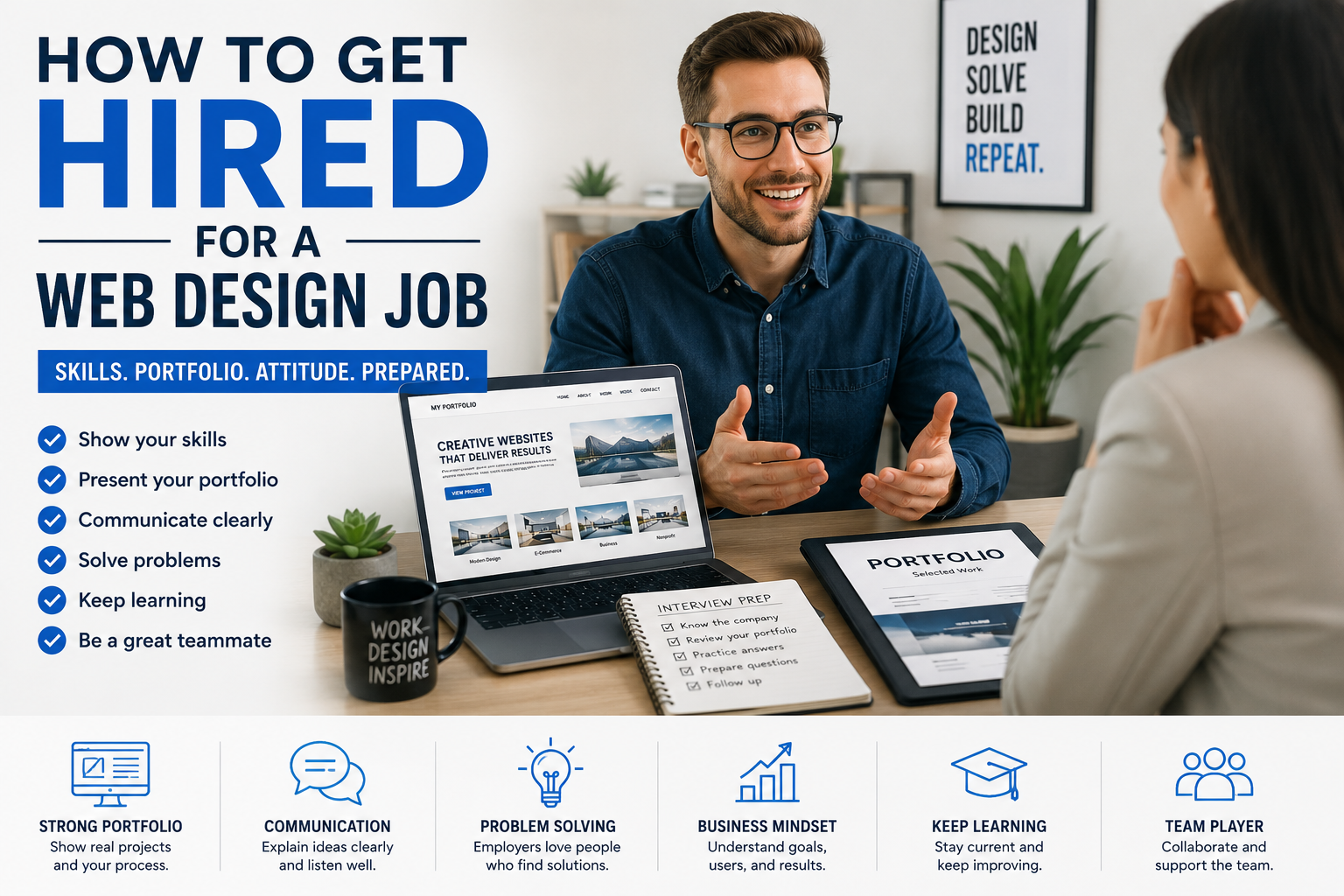
How to Get Hired for a Web Design Job
Getting an interview for a web design position is an important first step. But once you get the interview, you still have another job to do:
Convince the employer that you are the person they should hire.
Web design employers are not necessarily looking for the person who knows every programming language, design platform, or website builder. They are looking for someone who can contribute to their team, create quality work, solve problems, communicate effectively, and continue learning.
If you want to know how to get hired for a web design job, focus on demonstrating what you can actually do and how those abilities can help the employer.
Understand What the Employer Actually Needs
Before your interview, go back to the original job description.
Read it carefully.
Separate the requirements into three categories:
Skills you already have
These are the qualifications you should be prepared to demonstrate confidently.
Skills you have some experience with
Be ready to explain your current level of experience and how you are improving.
Skills you don’t have yet
Research them before the interview so you at least understand what they are and why the employer uses them.
Do not pretend to know something you don’t.
An employer can often discover very quickly when a candidate has exaggerated technical experience.
A better response is:
“I haven’t worked extensively with that platform yet, but I have worked with similar systems and I’m comfortable learning new tools.”
Then explain the related experience you do have.
Know Your Portfolio Inside and Out
If you included a portfolio with your application, expect to discuss it.
An interviewer might pull up one of your websites and ask:
Why did you choose this layout?
Why is the call-to-action located there?
How did you approach the mobile version?
What part of the website did you personally create?
What was the biggest challenge?
What would you change if you rebuilt it today?
You should be able to explain your decisions.
This is why copying a template and changing a few colors does not necessarily demonstrate web design ability.
An employer wants to understand how you think.
Explain the Purpose Behind Your Designs
Try not to describe your portfolio like this:
“I used WordPress and Elementor to build this website.”
That explains the tools, but not your thinking.
A stronger explanation might be:
“The business wanted more service inquiries, so I reorganized the homepage around its primary services and made the contact options easier to find, particularly on mobile devices.”
Now you are talking about business objectives.
That distinction matters.
Businesses generally do not build websites simply because they want websites.
They want websites to accomplish something.
That might be generating leads, booking appointments, selling products, answering customer questions, establishing credibility, attracting local customers, or supporting another part of the company’s marketing.
Show that you understand the difference.
Demonstrate Your Technical Skills
Different web design jobs require different levels of technical knowledge.
Depending on the position, an employer may be interested in experience with technologies and platforms such as:
- HTML
- CSS
- JavaScript
- WordPress
- Shopify
- Webflow
- Squarespace
- Wix
- Figma
- Adobe design tools
- Responsive design
- UX/UI principles
- Website accessibility
- SEO
- Analytics
You do not need every skill for every position.
The important question is whether your abilities match the work the employer needs you to perform.
When possible, demonstrate your skills with actual projects rather than simply listing technologies on your résumé.
Show That You Understand Mobile Design
A website that looks good on a desktop computer but performs poorly on a smartphone is not a finished website.
Be prepared to discuss responsive design.
You may be asked how you handle navigation on smaller screens, adjust layouts, prioritize content, resize typography, optimize images, or test a website across different screen sizes.
Your own portfolio website should also work properly on mobile devices.
If you claim responsive design as a skill, your portfolio is one of the first places an employer can verify it.
Learn Basic SEO
You do not necessarily need to become an SEO specialist to work as a web designer.
However, understanding basic search optimization can make you more valuable.
A web designer should understand concepts such as descriptive page titles, heading structure, crawlable navigation, image optimization, page performance, mobile usability, internal linking, and creating logical website structures.
SEO and web design frequently overlap.
A beautiful website that creates unnecessary technical barriers for search engines or makes important information difficult to find can create problems for the business.
Being able to communicate with SEO specialists can also make you a stronger member of a larger web team.
Understand Website Performance
Website speed and performance are also useful areas of knowledge.
You should understand common factors that can slow down a website, including unnecessarily large images, excessive scripts, poorly configured plugins, third-party resources, and overly complicated page designs.
You do not need to memorize every performance metric.
You should, however, understand that website performance affects the user experience and should be considered during the design and development process.
Show That You Can Solve Problems
Web design involves constant problem solving.
A layout breaks.
A plugin conflicts with something else.
A mobile menu stops working.
A client wants something that does not fit the existing design.
Content is missing.
A deadline changes.
A website looks different in another browser.
Employers want people who can work through problems.
During your interview, you may be asked something similar to:
“Tell me about a difficult problem you encountered on a website and how you solved it.”
Prepare an example before the interview.
Explain:
The problem → What you investigated → What you tried → The solution → What you learned
The employer is not simply interested in whether you solved the problem.
They are learning how you approach problems.
Communication Skills Matter
Web designers rarely work completely alone.
You may need to communicate with clients, developers, writers, photographers, SEO specialists, project managers, salespeople, business owners, and other designers.
That means communication can be an important part of the job.
Can you explain a technical issue without overwhelming a nontechnical client?
Can you accept feedback?
Can you explain why you recommend one approach over another?
Can you ask questions when project requirements are unclear?
Can you disagree professionally?
A technically talented designer who cannot communicate effectively can be difficult to integrate into a team.
Be Ready to Receive Criticism
Design is subjective.
Someone will eventually dislike something you created.
That does not automatically mean your design is bad.
It also does not automatically mean the other person is wrong.
An interviewer may ask how you handle criticism or design revisions.
Avoid giving the impression that you become defensive when someone changes your work.
Instead, explain how you determine what the client or team is trying to accomplish.
Sometimes feedback reveals a legitimate usability or business issue.
Other times, the solution may require explaining why you made a particular design decision.
Professional web design requires both confidence and flexibility.
Research the Company Before the Interview
Do not walk into an interview knowing nothing about the business.
Visit the company’s website.
Understand its services.
Look at examples of its work if they are available.
Learn what types of customers it serves.
Review the job description again.
This research helps you ask better questions.
Instead of asking:
“What does your company do?”
you might ask:
“I noticed you build a lot of websites for service businesses. Would most of the projects I’d work on be new website builds or redesigns of existing sites?”
The second question demonstrates that you prepared for the conversation.
Be Prepared for a Practical Test
Some employers may ask web design candidates to complete a skills assessment or design exercise.
You might be asked to create a layout, modify an existing page, troubleshoot a problem, critique a website, or explain how you would approach a project.
If this happens, pay attention to the instructions.
Do not rush simply because you want to demonstrate speed.
The employer may be evaluating much more than the finished design.
They could also be evaluating how you interpret requirements, organize your work, make decisions, communicate questions, and respond to feedback.
Don’t Try to Know Everything
One of the easiest ways to weaken an interview is to pretend you are an expert in everything.
Web design is too broad.
A person could spend years learning WordPress alone, while another designer specializes in Shopify, UX, front-end development, accessibility, e-commerce, or conversion optimization.
It is perfectly reasonable to say:
“I don’t know.”
Just don’t stop there.
Try:
“I haven’t encountered that particular problem before, so I don’t want to guess. I would start by checking the documentation and identifying whether the issue is coming from the theme, plugin, browser, or custom code.”
That response demonstrates honesty and problem-solving ability.
Show That You Continue Learning
Web design changes constantly.
Platforms change.
Design trends change.
Browser capabilities change.
Search engines change.
Accessibility practices evolve.
New tools appear.
AI is also changing how designers research, write, prototype, code, troubleshoot, and manage website projects.
Employers benefit from designers who can adapt.
Be prepared to explain how you continue learning.
That could include building practice projects, following documentation, taking courses, experimenting with new tools, reading industry resources, or solving problems through hands-on work.
Ask Good Questions at the End
Most interviews eventually include:
“Do you have any questions for us?”
Have some prepared.
You might ask:
What would a typical website project look like for someone in this position?
What would you want the person you hire to accomplish during the first 90 days?
What platforms does your team use most frequently?
How are website projects divided between designers, developers, content writers, and SEO specialists?
What does success look like in this position?
These questions help you evaluate the job while demonstrating that you are thinking seriously about how you would fit into the organization.
Follow Up After Your Web Design Interview
After the interview, send a short thank-you message.
Thank the interviewer for their time.
Mention something specific you discussed.
Reinforce your interest in the position.
Keep it brief.
The purpose is not to pressure the employer.
It is simply another opportunity to demonstrate professionalism and remind them why you are interested in the job.
What If You Don’t Get the Web Design Job?
You will not get every position you interview for.
That is normal.
Try to turn unsuccessful interviews into information.
Ask yourself:
Were there technical questions I struggled to answer?
Was my portfolio strong enough?
Did I explain my projects clearly?
Was I missing an important skill?
Did I research the company sufficiently?
Did another candidate simply have more relevant experience?
When appropriate, you can politely ask the employer whether they have any feedback that could help you improve.
You may not receive a response, but occasionally you will get valuable information.
Then use it.
Your next interview should be stronger than your previous one.
From Web Design Interview to Web Design Job
Learning how to get hired for a web design job involves more than learning how to build attractive websites.
You need to demonstrate technical ability, design judgment, problem-solving skills, communication skills, business awareness, and a willingness to continue learning.
Your portfolio gets their attention.
Your résumé establishes your qualifications.
Your interview demonstrates how you think.
Your communication shows what you may be like to work with.
And your preparation shows how seriously you take the opportunity.
If you have not reached the interview stage yet, start with our guide on How to Get a Web Design Job Interview.
Once you land the interview, return to this guide and prepare yourself to turn that interview into your next web design job.
Getting the interview opens the door. Showing the employer how you can contribute is what can get you hired.