The Worst Marketing Mistake Web Designers Make
You can be an excellent web designer and still struggle to find clients.
You can understand WordPress, build responsive websites, create attractive layouts, optimize pages for search engines, and know more about websites than most of the business owners you meet.
And still have an empty sales pipeline.
Why?
Because one of the biggest mistakes web designers make has almost nothing to do with web design.
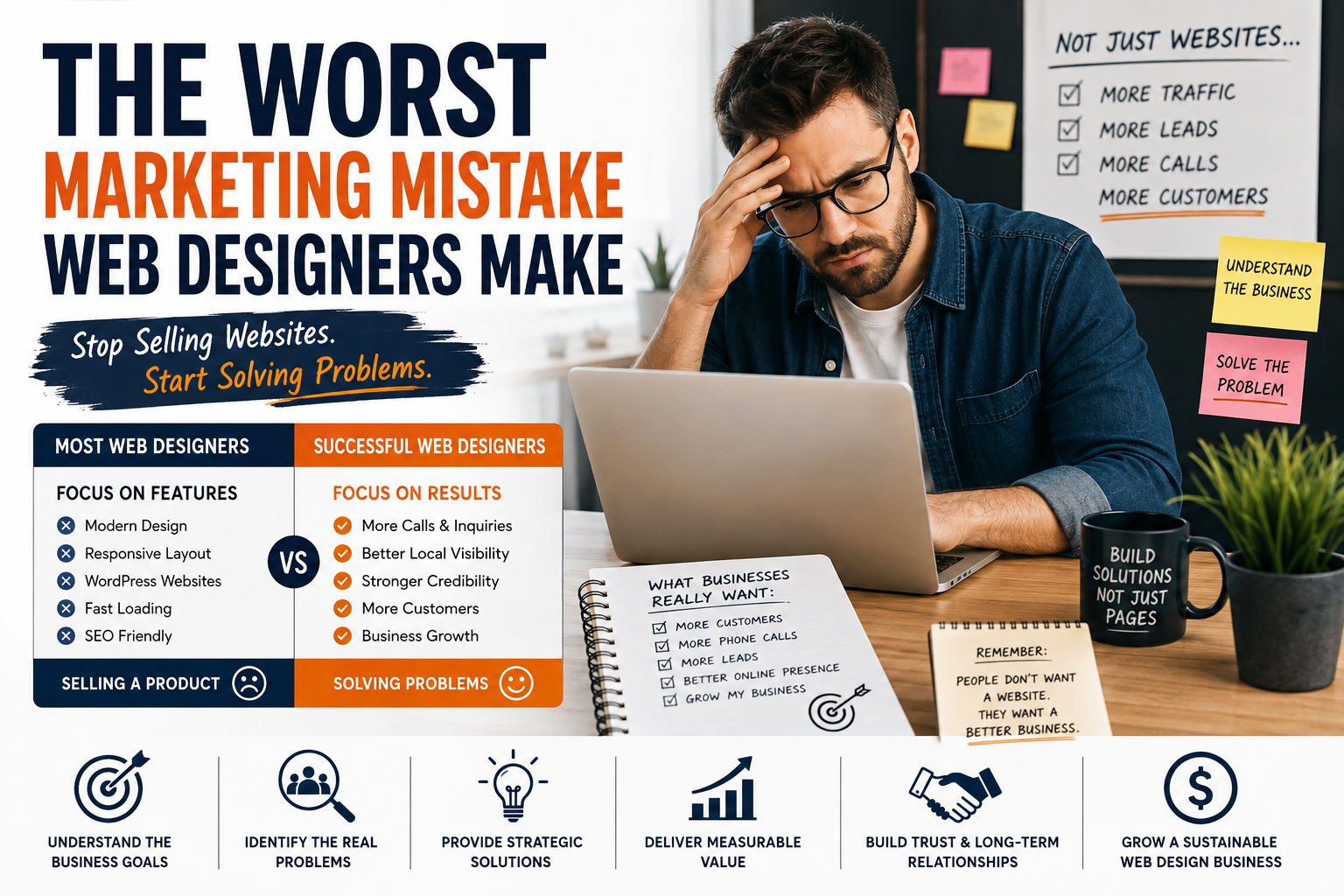
The Worst Marketing Mistake: Selling Websites Instead of Results
Many web designers market themselves by talking almost entirely about what they build.
They advertise:
Professional website design.
Responsive websites.
WordPress development.
Modern layouts.
Custom websites.
SEO-friendly design.
Fast-loading pages.
There is nothing inherently wrong with describing your services this way.
The problem is that these descriptions focus on the product rather than the reason the customer wants the product.
Most small-business owners don’t wake up thinking:
“I really need a responsive WordPress website with a modern user interface.”
They are much more likely to be thinking:
I need more customers.
I need more phone calls.
People can’t find my business online.
My competitor looks more professional than I do.
My website is embarrassing.
Customers keep asking questions my website should answer.
My business isn’t showing up when people search for my services.
That’s the marketing opportunity.
Stop Selling the Website
Imagine two web designers approaching the same local contractor.
The first says:
“I build professional, responsive WordPress websites with modern designs.”
The second says:
“I help local service businesses turn their websites into a better source of calls, leads, and customer inquiries.”
Both may ultimately sell the customer a website.
But they are selling it from completely different perspectives.
The first designer is selling a product.
The second is connecting the product to a business objective.
That distinction can dramatically change how a potential customer perceives your service.
Business Owners Buy Solutions to Problems
This principle extends far beyond web design.
Businesses generally spend money because they want to solve a problem, reduce a risk, save time, improve an operation, increase revenue, or create an opportunity.
A website can contribute to several of those objectives.
For example, a plumber may need a website because potential customers cannot easily find information about emergency services.
A dentist may need a redesigned website because it is difficult to use on mobile devices.
An auto repair shop may need clearer service pages so customers understand what types of repairs it performs.
A landscaping company may need a better project gallery to demonstrate the quality of its work.
A property services company may need a website because relying primarily on social media gives prospective customers limited information about the company and its services.
The website is the deliverable.
The business problem is the reason for buying it.
Your Homepage May Be Making This Mistake
Look at the headline on your own web design website.
What does it say?
Something like:
Professional Web Design for Small Businesses
That tells visitors what you do.
But compare it with:
Turn Your Website Into a Better Source of Leads for Your Business
or:
Websites Built to Help Local Businesses Get Found, Build Trust and Generate More Inquiries
Those messages immediately connect web design with something the business owner cares about.
Your homepage should certainly explain that you design websites.
But it should also explain why that matters.
Your Portfolio Can Make the Same Mistake
Web design portfolios often consist of screenshots.
Project #1.
Screenshot.
Project #2.
Screenshot.
Project #3.
Screenshot.
The visitor sees that you can make websites.
But what else do they learn?
Instead of only showing the finished website, explain the project.
For example:
The Problem
The company’s old website did not clearly explain its primary services and was difficult to navigate on mobile devices.
The Solution
The website was reorganized around the company’s major services, mobile navigation was simplified, and prominent contact options were added.
The Goal
Make it easier for prospective customers to understand the business and contact the company.
Now your portfolio demonstrates more than visual design.
It demonstrates problem solving.
Don’t Lead With Technology
Another common marketing problem is assuming customers care about your tools as much as you do.
Web designers naturally talk about:
WordPress.
Elementor.
Divi.
Webflow.
Shopify.
CSS.
JavaScript.
Hosting.
Plugins.
Page builders.
Frameworks.
Some customers care about these things.
Many do not.
A roofing company owner may not care whether you built the website with WordPress, a custom framework, or something else.
The owner cares whether prospective customers can find the company, understand its roofing services, see examples of previous work, trust the business, and request an estimate.
Technology matters because it helps you deliver the solution.
It doesn’t always need to be the center of your marketing.
Sell Benefits Without Making Promises You Can’t Prove
There is an important distinction here.
Selling results does not mean promising results you cannot guarantee.
Avoid claims such as:
“Our websites will double your sales.”
“We guarantee you’ll rank #1 on Google.”
“This website will generate 100 leads per month.”
Unless you have a legitimate basis for a specific claim, don’t make it.
Instead, describe what the website is designed to accomplish.
For example:
Designed to make it easier for customers to contact your business.
Built around the services your customers are searching for.
Structured to clearly communicate what your company does and where it operates.
Designed for customers using both desktop and mobile devices.
These statements communicate business value without inventing results.
Find the Problem Before You Pitch the Website
This changes the sales conversation too.
Instead of immediately asking:
“Do you need a new website?”
investigate the business.
Look at its current website.
Look at the mobile experience.
Look at the navigation.
Look at its service pages.
Look at how easily you can find contact information.
Look at whether the site clearly explains the company’s service area.
Look for missing or outdated information.
Then identify actual opportunities.
Your conversation can become:
“I noticed you offer five major services, but only two are explained on your website.”
or:
“I looked at your website on my phone and had trouble finding the estimate request.”
or:
“Your website has some excellent project photos, but they’re buried several clicks into the site.”
That is a much stronger starting point than:
“Hi, I’m a web designer. Would you like a new website?”
Become a Business Problem Solver
This is where web designers can separate themselves from competitors.
Don’t only learn how to build websites.
Learn how businesses use websites.
Understand:
- Lead generation
- Calls to action
- Local SEO
- Google Business Profile
- Conversion paths
- Customer reviews
- Service pages
- Location pages
- Contact forms
- Analytics
- Content marketing
- Website performance
- Mobile usability
You do not have to become an expert in every area.
But the more you understand the relationship between a website and the rest of a company’s marketing, the easier it becomes to have meaningful conversations with business owners.
Ask Better Questions
When meeting a prospective web design client, don’t spend the entire conversation talking about yourself.
Ask questions.
For example:
How are customers finding you now?
What services are most important to your business?
Which services would you like to sell more of?
What do customers usually ask before hiring you?
What is frustrating about your current website?
Do most customers call, email, visit, or request an estimate?
Which geographic areas are most important to your business?
What would you like the website to accomplish that it isn’t accomplishing now?
These questions help you understand what the customer actually needs.
They also provide the information you need to recommend the right website.
Don’t Compete Only on Price
Selling “a website” can quickly turn your service into a commodity.
One designer charges $500.
Another charges $1,500.
Another charges $5,000.
A do-it-yourself website builder may cost considerably less.
AI can now generate website layouts and code.
If the customer believes all websites are essentially interchangeable, price becomes one of the easiest ways to compare providers.
That is not where you want to compete.
Instead, demonstrate the additional value you bring.
You may understand local SEO.
You may help organize the company’s services.
You may write or improve website content.
You may optimize the company’s Google Business Profile.
You may understand lead generation.
You may provide ongoing maintenance.
You may help the business develop a broader online presence.
You are no longer simply selling pages.
You are offering expertise.
AI Makes This Even More Important
AI is making it easier to generate layouts, write code, create graphics, draft content, and perform other tasks that once required considerably more time.
That does not eliminate the need for web designers.
But it does increase the importance of providing value beyond simply assembling a website.
A web designer who understands the client’s business, customers, local market, search visibility, messaging, conversion goals, and overall marketing strategy can provide something much more valuable than a collection of web pages.
The future opportunity may increasingly belong to designers who understand both:
Web design + business marketing.
Change the Way You Describe Your Services
Try this exercise.
Write down the services you currently sell.
Perhaps your list looks like this:
Website Design
Website Redesign
SEO
Google Business Profile Optimization
Website Maintenance
Now write the business reason beside each service.
Website Design → Establish a professional online presence and turn visitors into inquiries.
Website Redesign → Improve an outdated website that may be hurting credibility or usability.
SEO → Help the business become more discoverable when potential customers search online.
Google Business Profile Optimization → Improve the information customers see when researching the business locally.
Website Maintenance → Keep important website information, software, and functionality current.
You still sell the same services.
But you are learning to communicate their value.
The Best Web Designers Don’t Just Build Websites
The biggest marketing mistake web designers make is assuming that being good at web design automatically makes them good at marketing web design.
It doesn’t.
Those are two different skills.
You need to know how to build.
But you also need to know how to communicate why what you build matters.
Stop making the website the hero of your marketing.
Make the customer’s problem the starting point.
Then show how your expertise can help solve it.
Instead of saying:
“I build websites.”
start thinking:
“I help businesses improve how they attract, inform, and convert customers online.”
That is a much bigger conversation.
And it gives a prospective client a much better reason to talk to you.
Build the Business, Not Just the Website
Learning web design gives you a valuable skill.
Learning how to market that skill can turn it into a business.
If you are trying to grow a web design business, your next step should be learning how to consistently find prospects, identify their problems, communicate your value, and turn conversations into paying projects.
Web Design Business Builder is designed to help web designers develop the business side of web design — from marketing and finding clients to building services that businesses actually want to buy.
Because knowing how to build a website is only the beginning.
Knowing how to sell the value behind it is what helps build the business.